

By Beverly Belcher Woody
Last week, we explored the life of John Marion Taylor, born along Rock Castle Creek in the 1840s and later moved west to Missouri with his family in the 1860s. Among Taylor’s most treasured possessions was a powder horn that once belonged to Patrick County’s John Brammer, carried during the War of 1812. The horn was brought to Missouri in 1859 by Jeff Vaughn and later used again during the War of 1861–1865, never falling into enemy hands—a tangible link between generations, wars, and families.

That detail raised a new question: Who was Jeff Vaughn?
Jeff Vaughn was almost certainly John Jefferson Vaughn, son of Wilson Turner Vaughn and Susannah DeHart Vaughn. Susannah DeHart’s sister, Melinda DeHart Taylor, was the mother of John Marion Taylor, making Taylor and Jeff Vaughn first cousins.
Wilson Turner Vaughn, son of Joseph Vaughn and Nancy Ann Via, was born May 10, 1810, in Floyd County, Virginia. He married Susannah DeHart of the Charity community of Patrick County on November 12, 1835. Susannah was the daughter of Elijah K. DeHart and Mary Ellyson Jordan, placing the Vaughn family firmly within some of Patrick County’s oldest and most interconnected lineages.
Together, Wilson and Susannah Vaughn raised six sons in the Rock Castle Post Office district of Patrick County:
John Jefferson “Jeff” Vaughn (1836–1866)
Elijah DeHart Vaughn (1838–1883)
James T. Vaughn (1844–1863)
Columbus Penn Vaughn (1844–1927)
Thomas Averett Vaughn (1851–1928)
Christopher Green Vaughn (1854–1937)
Jeff Vaughn married Nancy Elizabeth Young, daughter of John Young and Adelphia Turner Young, on July 10, 1856. By the 1860 census, Jeff and Nancy were living in Boons Lick, Howard County, Missouri, with their one-year-old daughter Victoria Alice Vaughn. Their second daughter, Zorah Martha Vaughn, was born in 1861.
When the Civil War began, Jeff returned to Virginia. Although he appeared on the roll of the 51st Virginia Infantry, family records indicate that he served as a courier with Company D of the 37th Virginia Cavalry. While passing through Nelson County, Jeff became ill and died at The Belmont House, which had been converted into a Confederate hospital. He was buried there, among 25–30 unmarked Confederate graves, a quiet and tragic end to a young life shaped by war.
Around this same period, Jeff’s brothers relocated to Willis, in the Burks Fork section of Floyd County, where their presence would shape the area for generations.
Much of what we know about the Vaughn family’s daily life comes from a deeply personal account titled “I Remember Grandpa Vaughn,” written by Thomas W. Dunn and published in Mountain Laurel, October 1988 (© 1988, with additional material © 1989).
Dunn wrote of his grandfather, Columbus Penn Vaughn, born in Patrick County in 1845 to Wilson Vaughn and Susannah DeHart Vaughn. At sixteen, shortly after the Civil War, Columbus joined the Confederate Army and spent three years fighting in the Valley of Virginia before being captured at Manassas and imprisoned at Point Lookout, Maryland, for the final six months of the war.
Dunn recalled that his grandfather rarely spoke of the war’s horrors, though he did tell of the long march to prison, sleeping on the courthouse lawn in Winchester, and later being released with nothing but a knapsack and blanket. One poignant memory involved a Union officer who shared a piece of bacon with the starving men—a moment of humanity at war’s end that Dunn never forgot.
After the war, Columbus married Julia Ann Hatcher, and together they raised fifteen children, ten of whom survived to raise families of their own, scattering Vaughn descendants across the country.
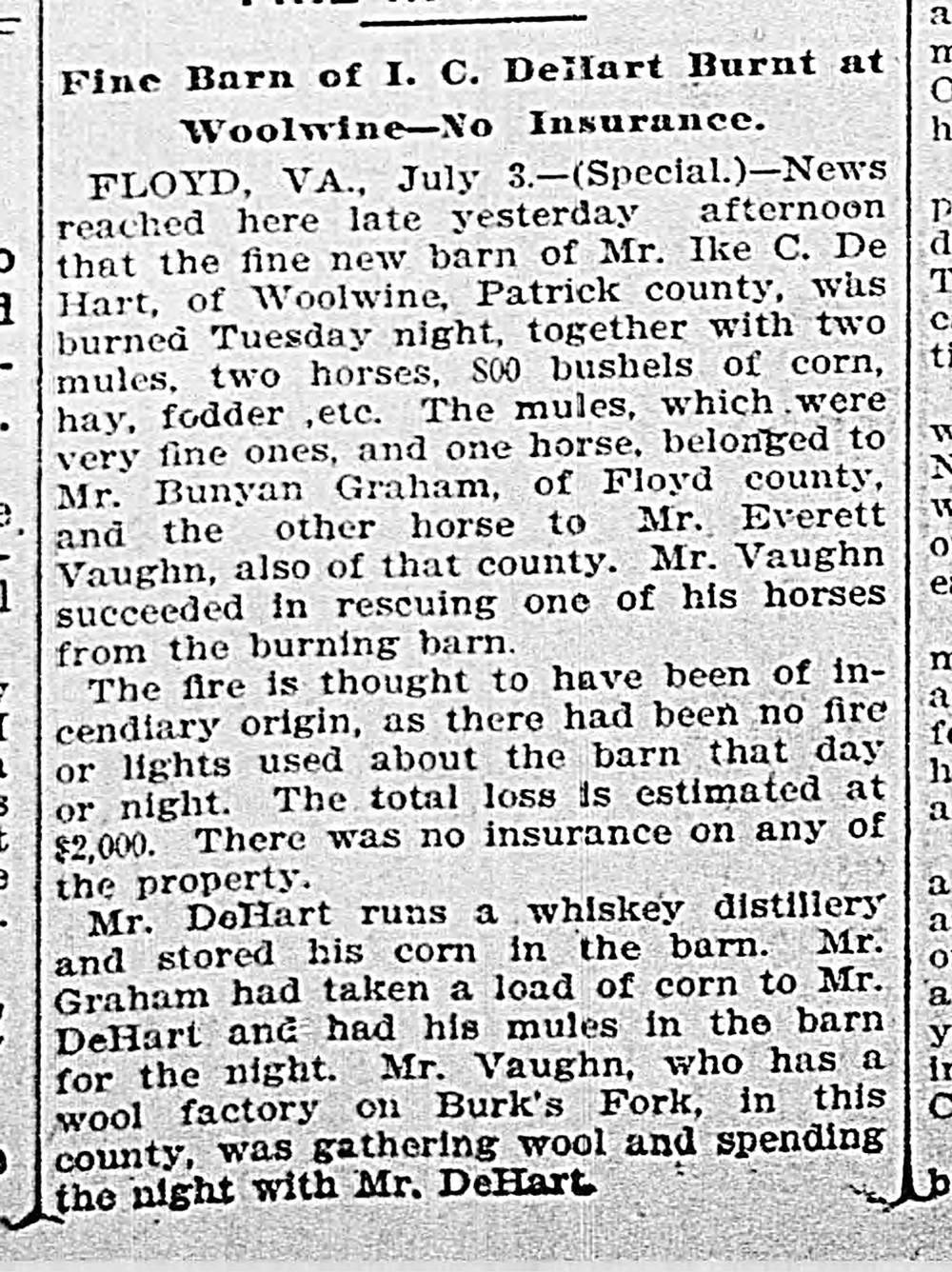
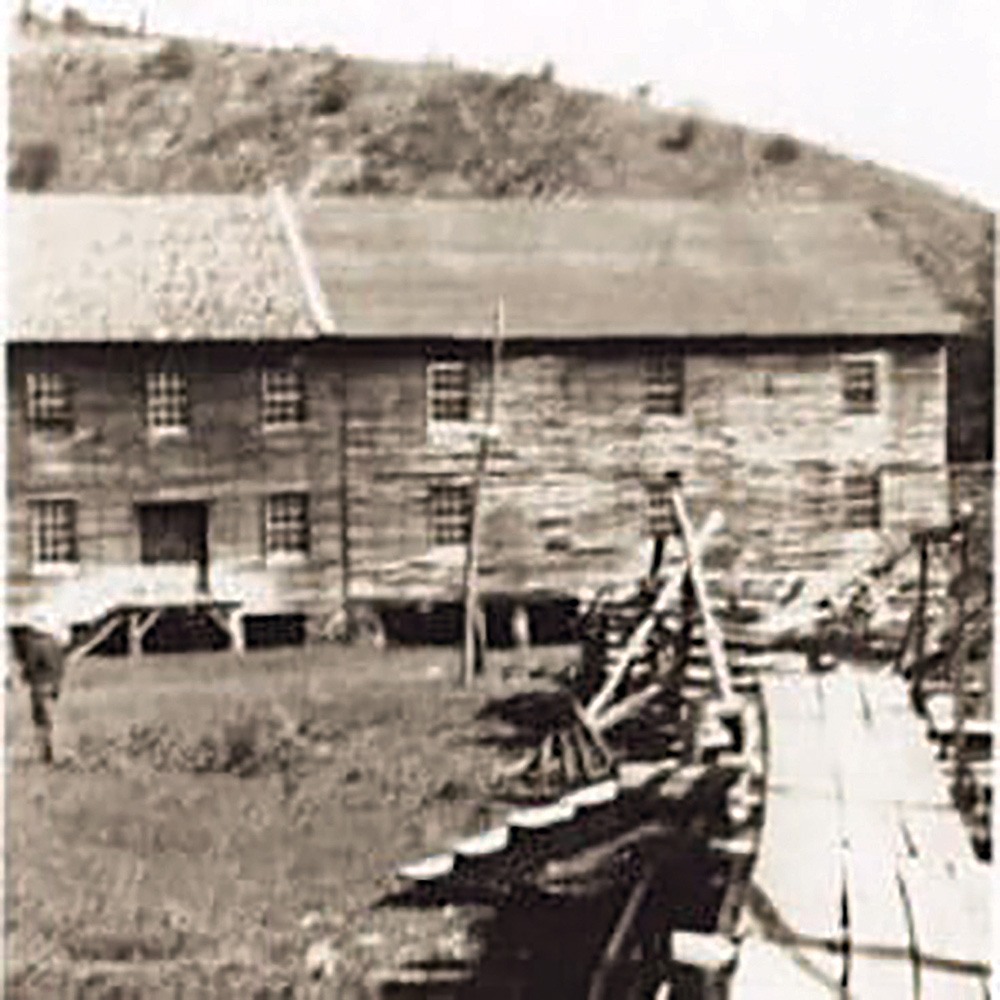
Columbus Penn Vaughn purchased the Bryant Hylton farm along Burks Fork Creek, at the foot of Buffalo Mountain, an area known for its rich meadow land and natural beauty. There, Columbus and his brother Green Vaughn built a water-powered woolen and grist mill, using an ancient mill race originally constructed for earlier grist operations.
Dunn described the mill’s toll system: one-eighth of a bushel of corn kept as payment, or eight pounds of wool and three dollars to produce a blanket. Customers arrived on horseback, carrying enormous rolls of wool tied to saddle horns — memories echoed by Elder J. M. Dickerson and Judge J. P. Burks, both of whom recalled seeing riders nearly hidden beneath their loads.
As the business expanded, new machinery was added in 1873, 1883, and 1901, including spinning machines, looms, and a copper dye vat over a century old. The installation was overseen by J. T. Dunn, an experienced weaver and the author’s father, who later married Columbus’s daughter Allie Vaughn. Together, Tom and Allie Dunn would operate the mill and farm.
Dunn’s recollections stretch beyond industry into the rhythms of mountain life: fishing trips along Burks Fork Creek, swimming in mill ponds, baptisms performed by Uncle Amos Vaughn, a Primitive Baptist preacher, and visits with Emma Vaughn, wife of Martin Vaughn, near the brick house built by Dunn’s great-grandfather.
He remembered the many preachers who stayed overnight, fed by Grandma’s and Mamma’s cooking, never charging for their services. He described his great-uncle Thomas Averett Vaughn, a dentist who made dentures and traveled “below the mountain” into Patrick County, and the famous “Wool Wagons” driven by men like Henry Nester, Walter Montgomery, and Harvey Vaughn, hauling wool and finished goods across Floyd County.
Today, the mill’s artistry lives on through preserved coverlets and blankets, some of which may be viewed online through The Old Church Gallery in Floyd, Virginia:
https://oldchurchgallery.org/collections/vaughns-woolen-mill-blanket
From Rock Castle Creek to Burks Fork, from Patrick County to Floyd County, the Vaughn family story is one of endurance, labor, faith, and memory. These men and women built mills, raised families, weathered wars, and carried their stories forward—not only in records and artifacts, but in the lived recollections of descendants who remembered every bend in the creek and every loom in the mill.
Through the careful preservation of family writings by Thomas W. Dunn and the enduring connections uncovered through genealogy, the Vaughn story reminds us that Patrick County’s pioneers did not simply pass through history — they wove themselves into it, thread by thread, generation by generation.
And like the coverlets produced along Burks Fork Creek, their legacy remains both beautiful and enduring. For questions, comments, or story ideas, please contact Woody at rockcastlecreek1@gmail.com or 276-692-9626.